
Seedance 2.5 Explained: What's Actually Confirmed vs Still Rumored
ByteDance's Seedance 2.5 promises 30-second one-shot video and 50 reference inputs, but public API access and exact specs aren't fully locked in yet. Here's exactly what's confirmed, what's still rumored, and how to access it today.

Umer Khan has spent the last two years building and testing AI-assisted content workflows for YouTube, from scripting to 2D animation. He writes about what actually works in AI video production including the parts that don't.
Quick answer: Seedance 2.5 is ByteDance's newest AI video model, unveiled June 23, 2026 at the Volcano Engine FORCE conference. Confirmed features include native 30-second single-shot video generation (double Seedance 2.0's length), support for up to 50 multimodal reference files, native multilingual audio, and frame-local "redraw" editing. A full public API with locked pricing is not yet live as of this writing — some reported specs, including guaranteed 4K output on 2.5 itself, remain unverified.
If you've searched "Seedance 2.5" recently, you've likely hit a wall of conflicting claims — one site says it's fully live, another says it's still in staged rollout. Both are partly right, and untangling that is the point of this guide.
1. What Is Seedance 2.5?
Seedance 2.5 is the next-generation AI video model from ByteDance, following the Seedance 2.0 release that became the top-ranked model on the Artificial Analysis Video Arena for both text-to-video and image-to-video earlier in 2026. It generates video from a text prompt, a reference image, or a reference clip, with native audio built directly into the output rather than added afterward.
The headline shift from 2.0 to 2.5 is scale, not a new core capability. Where Seedance 2.0 produced polished short clips, 2.5 is built to generate a single, continuous sequence up to 30 seconds long in one pass, without stitching shorter clips together — which matters directly for keeping characters and scenes consistent across a longer story.
2. How Does Seedance 2.5 Work?
You provide an input — text, an image, a video clip, or a combination — and the model generates a single continuous video from it, incorporating native audio in the process rather than as a separate step. The meaningful technical jump is in how many reference inputs it can hold onto at once.
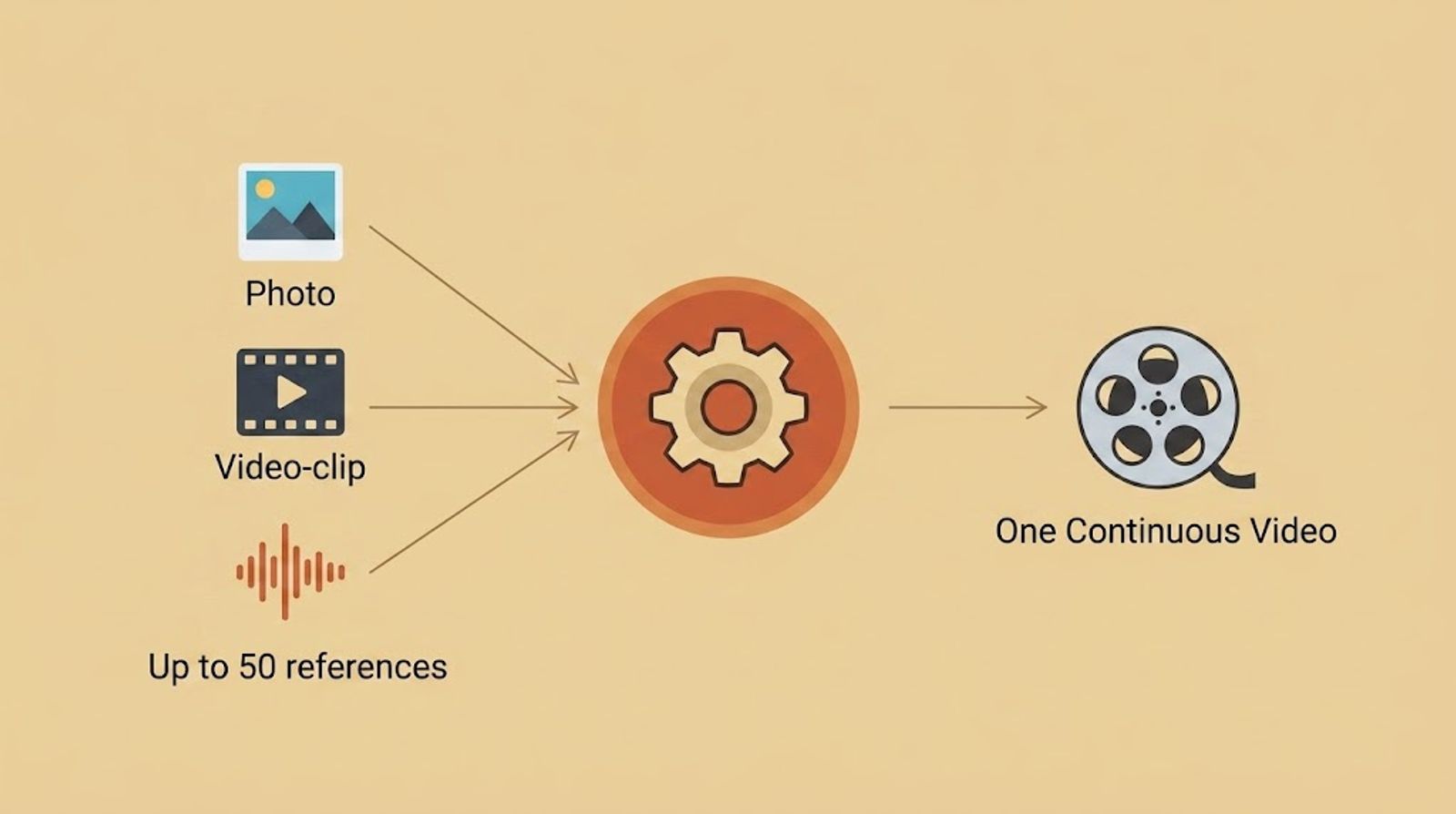
Seedance 2.5 accepts up to 50 multimodal reference assets in a single generation, combining images, video clips, and audio files, compared to 12 on Seedance 2.0. ByteDance has demonstrated this with ensemble scenes involving a large cast plus environment references, and with film previsualization work involving a detailed 3D model rendered into full video with stable structure through complex shots. That reference capacity is what enables the frame-local editing feature covered below — the model has enough held-onto context about the original scene to make a targeted fix without losing everything else.
3. Main Benefits
- Longer native output. 30 continuous seconds in one pass roughly doubles what Seedance 2.0 could do without stitching separate clips together.
- Far higher reference capacity. 50 multimodal assets versus 12 opens up ensemble-cast scenes and previsualization work that simply wasn't practical before.
- Frame-local "redraw" editing. Circle a specific mistake — a wrong hand, a wrong logo, an off detail — and fix just that region while the rest of the approved clip stays untouched.
- Native multilingual audio. Support for more than 10 languages built directly into generation, rather than requiring a separate dubbing pass.
- No forced migration cost on some platforms. At least one third-party platform (Seedance Studio) has made 2.5 the default model at no extra cost, with 2.0 still available as a fallback.
4. Problems and Limitations
This is the part most coverage of Seedance 2.5 glosses over, and it's worth being direct about it.

No locked public API or pricing yet. As of early August 2026, ByteDance's official model catalog and pricing pages still list the Seedance 2.0 family, not a callable Seedance 2.5 model ID — meaning production systems built on an assumed 2.5 API contract are building on an assumption, not a confirmed spec.
4K output is confirmed for Seedance 2.0, not verified for 2.5 itself. Multiple sources agree Seedance 2.0 gained a 4K upgrade alongside the 2.5 announcement. Whether 2.5 itself guarantees native 4K, or inherits a lower default resolution with 4K as an option, is not consistently confirmed across sources as of this writing.
Staged rollout means access varies by platform. Some third-party platforms report full public access already; ByteDance's own enterprise beta framing suggests broader public API access was still being finalized as of early July 2026. If you're evaluating this for a specific workflow, check the exact platform's current status rather than assuming uniform availability.
5. Seedance 2.5 vs Seedance 2.0 vs Seedance 2.0 (4K Update)
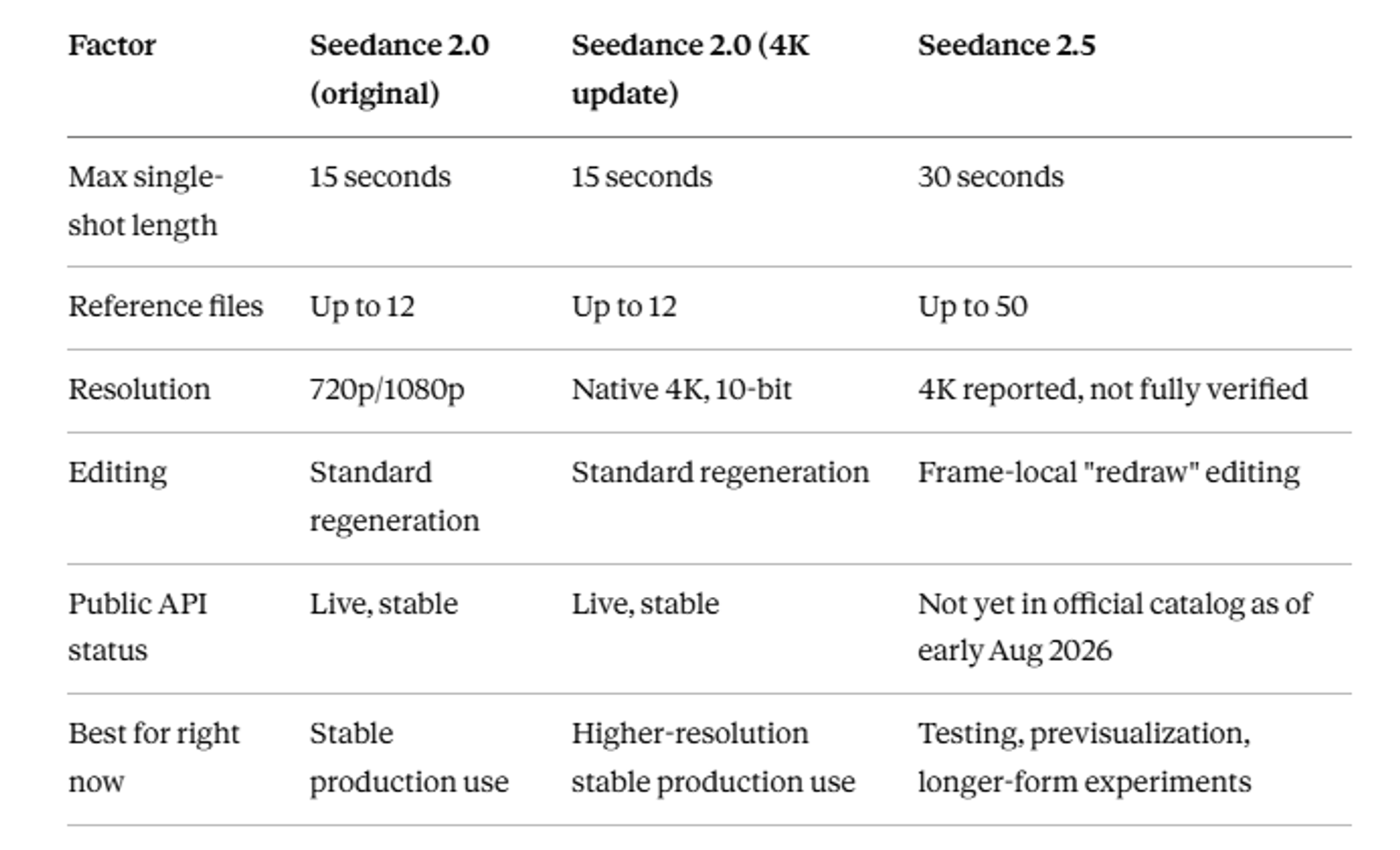
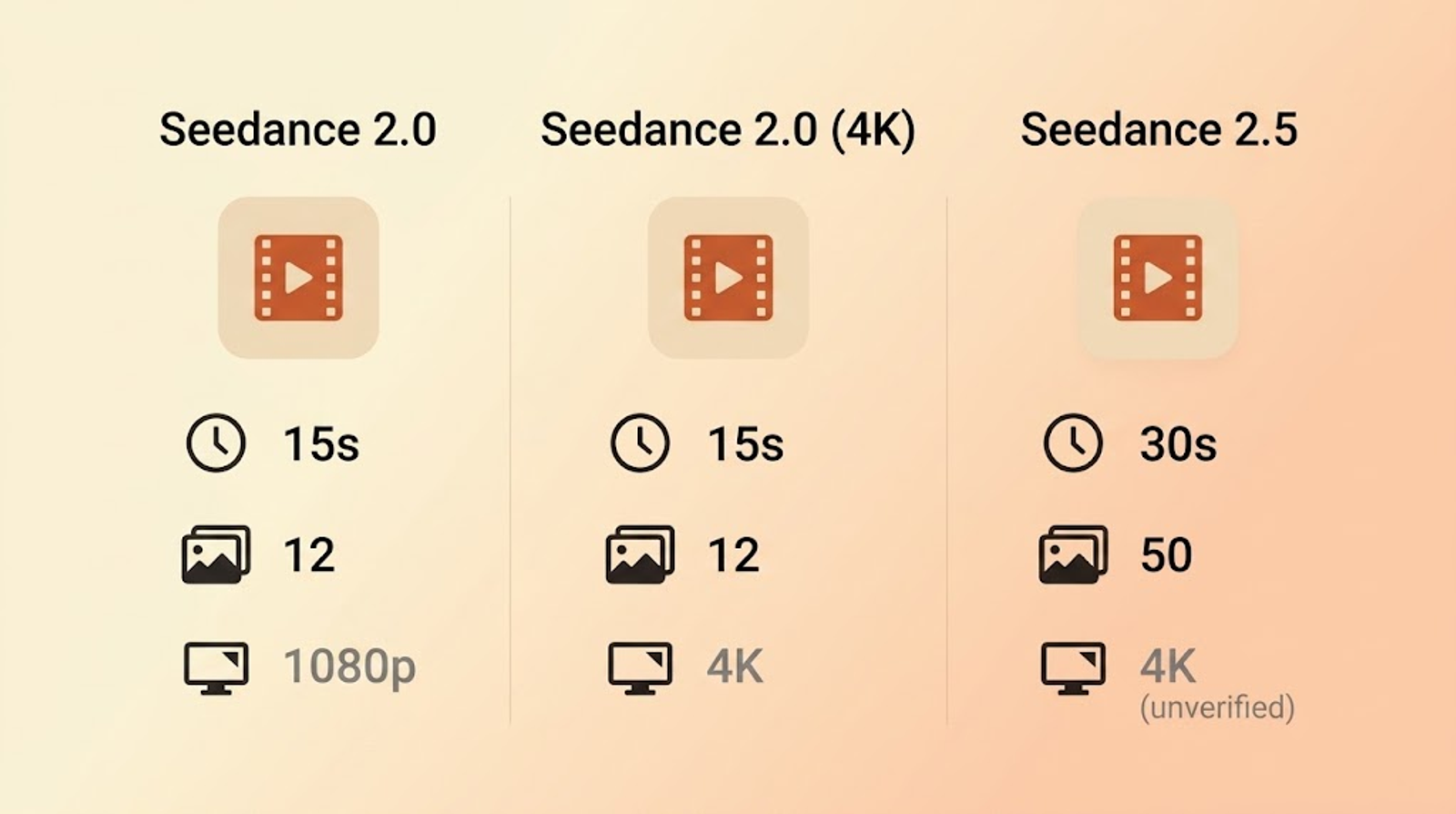
What Testing Access Across Platforms Actually Showed
Checking model availability across several third-party platforms rather than relying on a single source shows a genuinely mixed picture: some platforms (Seedance Studio) list 2.5 as their live default model with no waitlist, while ByteDance's own official channels frame it as staged enterprise rollout. That gap is normal for a major model launch — third-party platforms often get early or preview access before a model appears in the developer's own official pricing catalog. The practical implication: if a specific platform says 2.5 is live for you today, that's plausible and worth testing, but don't assume every access route (especially direct API integration) is equally available yet.
Recommended For You:
- Seedream 5.0 Pro's Region-Precise Editing Explained
- TikTok's Symphony Agent Runs on Seedance 2.0
- Why AI Character Consistency Is the Biggest Problem Nobody's Solved Yet
6. Real-World Use Cases
Advertising and brand films. A 30-second one-shot clip maps almost exactly onto a standard ad length, without the seams that come from stitching multiple shorter generations together.
Ensemble and cast-heavy scenes. The 50-reference ceiling is specifically demonstrated for scenes with a large cast plus environment references, holding many characters visually stable at once — directly relevant to the character-consistency problem covered elsewhere on this site.
Film previsualization. ByteDance's own demo involved a detailed 3D spaceship model plus material references rendering into a full video with stable structure through collision shots — production-pipeline work, not a casual demo case.
Fixing a specific mistake without a full redo. The frame-local redraw feature is built exactly for the common frustration of an otherwise-good clip having one visibly wrong detail — a logo, a hand, a background element.
7. How and Where to Access Seedance 2.5
Step 1: Check platform-specific availability first. Access is currently staged and inconsistent across platforms — some third-party tools list it as fully live, ByteDance's own official catalog had not added a callable model ID as of early August 2026.
Step 2: Start on a platform with confirmed public access if you need it now. Third-party platforms offering it as a default model with no waitlist are the more reliable route for immediate use, rather than waiting on official API confirmation.
Step 3: Treat exact specs as provisional until confirmed on your specific platform. Resolution, reference limits, and pricing can vary by access route until ByteDance publishes an official parameter table.
Step 4: If you're on Seedance 2.0 today, don't rush a full migration. Several sources describe the practical move as continuing to build on 2.0 while preparing a test set for 2.5, treating it as a migration target rather than an immediate production swap.
Where this fits for Auto Seedance users specifically: as with every Seedance-family update we've covered, whether and when 2.5's specific capabilities reach Auto Seedance depends on which model version is integrated at any given time — something we'll update this article to reflect once confirmed, rather than assume.
Final Thoughts
The honest state of Seedance 2.5, as of this writing, is a real and significant model with confirmed core upgrades — length, reference capacity, and targeted editing — wrapped in a rollout that hasn't fully settled yet. That gap between "announced" and "uniformly available" is normal for a major model release, not a red flag.
If you need something stable today, Seedance 2.0's 4K update is the safer production choice. If you're experimenting with longer-form or ensemble work, 2.5 is worth testing on a platform that already has it live.
Sources
- ByteDance's own Seed team blog post announcing Seedance 2.5's one-take creation and flexible referencing capabilities
- Volcano Engine FORCE conference launch coverage (June 23, 2026) from multiple independent AI-model tracking publications
- Cross-platform availability check comparing ByteDance's official model catalog status against third-party platform access as of early August 2026
- Consistency and reference-limit claims cross-referenced against our own prior coverage in "Why AI Character Consistency Is the Biggest Problem Nobody's Solved Yet"
Frequently Asked Questions
Is Seedance 2.5 available to the public right now?+
Partially. Some third-party platforms list it as their live default model, while ByteDance's own official model catalog had not added a public API listing for it as of early August 2026.
What's the single biggest upgrade in Seedance 2.5?+
Native 30-second one-shot video generation — double Seedance 2.0's 15-second limit — combined with a jump from 12 to 50 supported reference files.
Does Seedance 2.5 support 4K video?+
Seedance 2.0 was confirmed to gain native 4K output alongside the 2.5 announcement. Whether 2.5 itself guarantees 4K by default is not consistently confirmed across current sources.
How much does Seedance 2.5 cost?+
Official public pricing has not been locked in as of this writing. At least one third-party platform offers it at no extra cost as the default model on existing plans.
What is frame-local "redraw" editing?+
A feature letting you mark one specific problem area in a generated clip — a wrong hand, logo, or detail — and regenerate only that region, leaving the rest of the approved clip untouched.
Should I switch my workflow from Seedance 2.0 to 2.5 immediately?+
Most current guidance suggests continuing production work on the stable 2.0 line for now, while testing 2.5 in parallel, given the unlocked API status and unverified specs as of this writing.
Is Seedance 2.5 the same model Auto Seedance uses?+
Auto Seedance uses models from the Seedream and Seedance families, but which specific version is integrated at any given time isn't something we've independently confirmed as of this article's publish date.
Keep reading
Suggested Related Articles
GPT-6 Sol vs Luna: What OpenAI's Pricing Table Actually Means
GPT-6 Sol and Luna launched September 2026 with a pricing table that confused much of Reddit on day one. Here's the real cost breakdown, the naming trap versus GPT-5.6, and which model actually fits your work.

How to Automate Product Video From Your Ecommerce Catalog With AI
AI product video automation actually works two different ways — generative AI and template-based pipelines. Here's the full workflow, which tools fit which job, and what goes wrong once you scale past a handful of products.

10 Best AI Video Generators for Faceless YouTube Channels in 2026 (Real Costs, Real Workflows)
We compared 10 AI video generators for faceless YouTube channels in 2026 — real creator-reported costs, an honest look at one-click vs. manual workflows, and which tool actually fits your format and budget, not just the highest-rated demo reel.
How to Use ChatGPT Images 2.5 for AI Photo Editing
The prompt structure that makes ChatGPT Images 2.5 editing work, plus Sketch, comments, templates, Flare vs Sunburst, pricing, and the real limits.