How to Use Agentic AI for Content Creation (And Why It's Not What Most People Think)
Agentic AI is reshaping content production — from operating tools yourself to briefing an agent that plans, generates, and delivers. Here's the real difference, what it can and can't do yet, and where generative tools still fit in.

Umer Khan has spent the last two years building and testing AI-assisted content workflows for YouTube, from scripting to 2D animation. He writes about what actually works in AI video production including the parts that don't.
For two years, "using AI for content" meant one thing: open a tool, type a prompt, get one asset, repeat. Script in ChatGPT. Image in one tab. Video in another. Voiceover in a third. You were the glue holding five apps together.
That's starting to change, and the shift has a name most creators haven't fully understood yet — agentic AI. Not another generator. Something that operates the generators for you.
This is a long one, because the difference matters more than the buzzword makes it sound, and getting it wrong wastes real time.
1. What Agentic AI Actually Means
Strip away the marketing language and it's simpler than it sounds. An agentic AI system is one that takes a goal, works out the steps to reach it on its own, and carries those steps out — without you approving each individual action along the way.
Compare that to what you're doing right now with most AI tools. You write a prompt. The tool gives you one output. You look at it, decide what's next, and write another prompt. You're the planner. The tool is just execution for a single step.
Agentic AI moves the planning into the tool itself. You describe the outcome. It figures out the sequence of steps and runs them.
2. Agentic AI vs the Generative AI You're Already Using
This distinction gets muddy fast because both categories use the same underlying models. The difference isn't the model. It's who's doing the deciding.
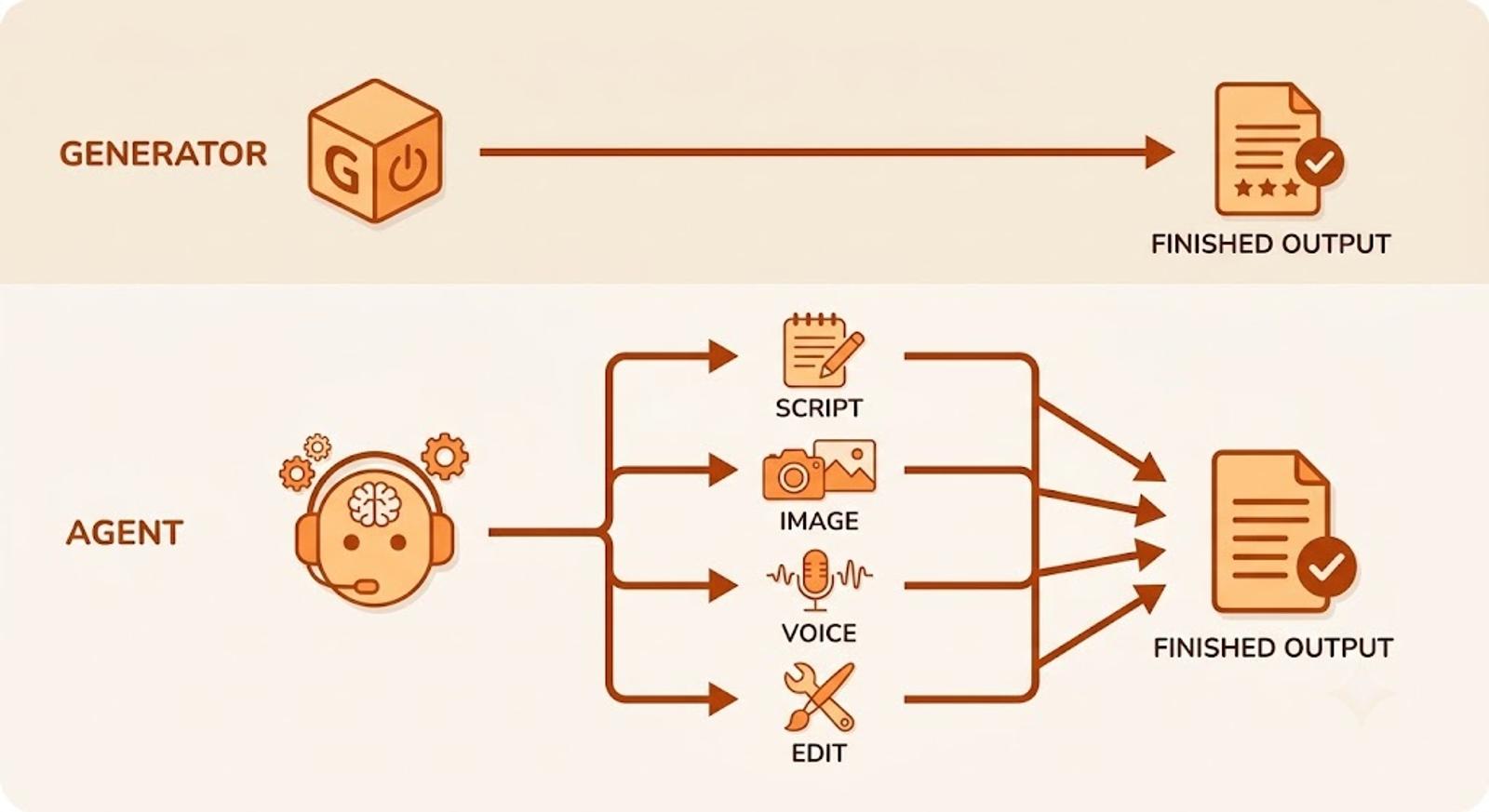
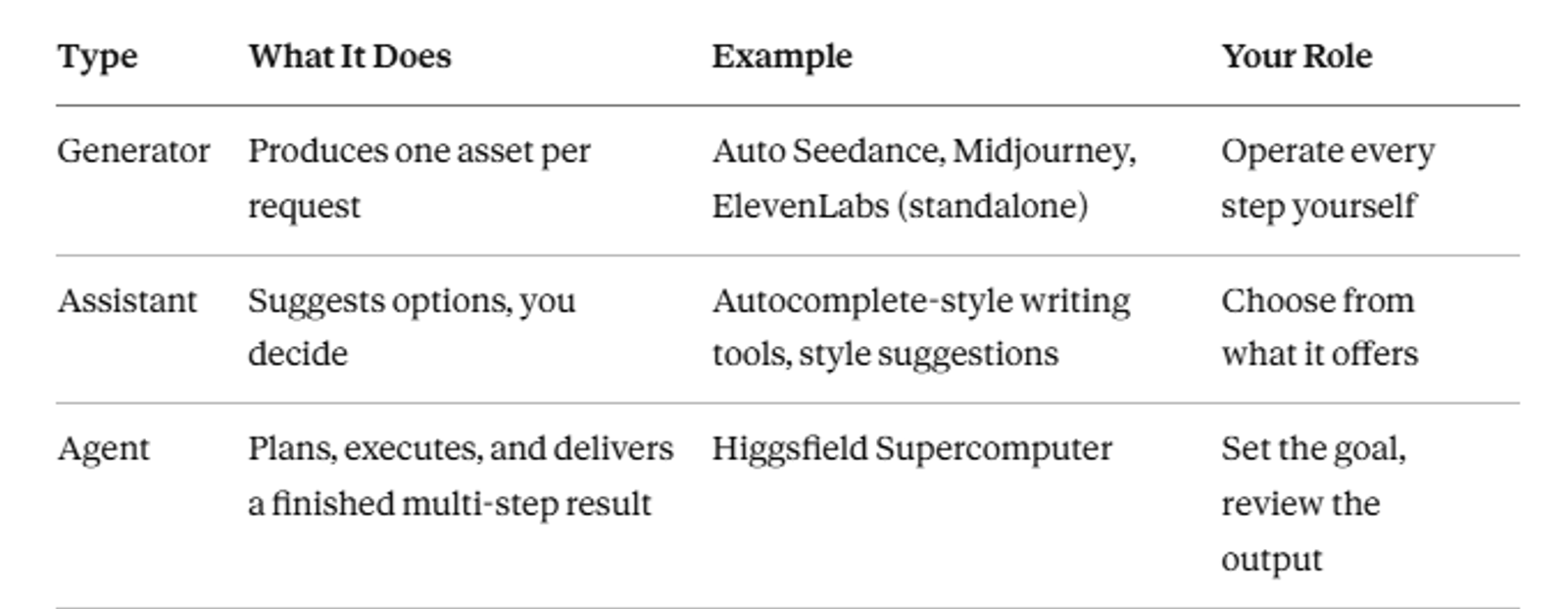
A generative tool — an image generator, a text-to-video model, a voice cloner — does exactly one job per request. You ask, it answers, the interaction ends. Auto Seedance works this way right now. So does Midjourney. So does ElevenLabs on its own.
An agentic system chains several of those jobs together toward a goal you set once. Instead of "generate this image," you'd say something closer to "produce a 30-second product video for this item," and the system decides it needs a script, then visuals, then voiceover, then an edit — and runs all four without you re-prompting between each one.
3. The Three Traits That Make Something an Agent
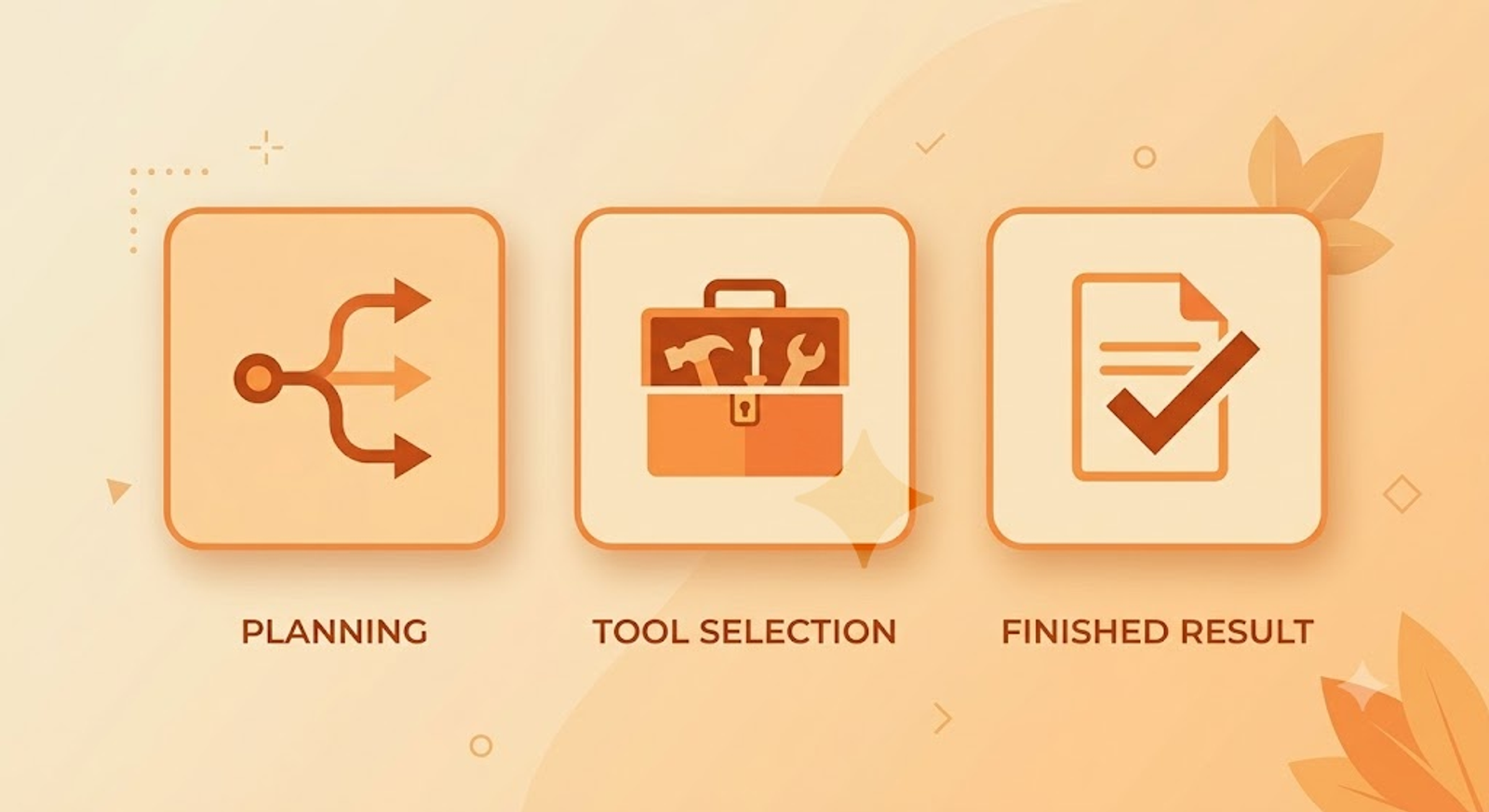
Not every tool that calls itself an "AI agent" actually qualifies. Three things need to be true at once:
- It plans multi-step work. A single generation isn't planning. Breaking a goal into a sequence of dependent steps is.
- It selects its own tools for each step. It decides which model or method fits each part of the job, rather than you choosing manually.
- It delivers a finished result, not a list of suggestions you still have to act on yourself.
Miss any one of those three and you've got an assistant or a generator wearing agent branding. A tool that suggests three headline options you pick from isn't an agent — you're still doing the deciding. A tool that writes the headline, picks the image, assembles the video, and hands you a finished file is.
4. How This Plays Out in a Real Content Workflow
Take a concrete example: a weekly explainer video for a faceless channel.
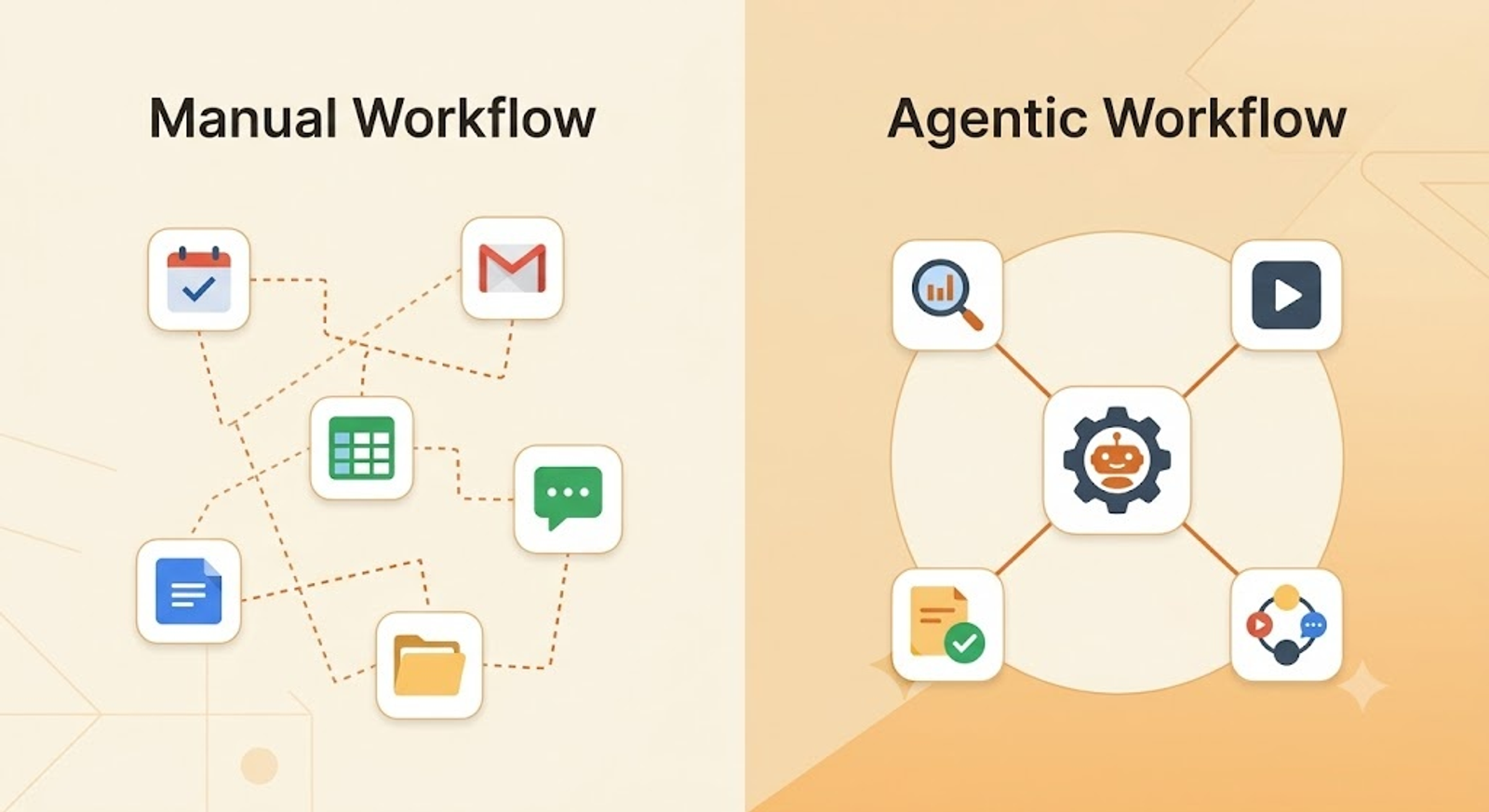
The generative-AI way, the way most creators still work: open a chat tool for the script, copy it into a video-generation tool scene by scene, generate a voiceover separately, drop everything into an editor, sync it manually, export, upload. Five to six separate tools, five to six separate decision points, your attention required at every handoff.
The agentic way: you describe the video — topic, length, tone, target platform — once. The agent researches the angle, writes the script, generates the visual sequence, produces a voiceover, times the edit, and delivers a finished file. You review the result and either approve it or ask for a specific revision. One conversation instead of six tool switches.
The output quality ceiling isn't necessarily higher with an agent. What changes is how much of your own attention the production process consumes.
5. Where This Trend Came From (Beyond Content)
Agentic AI didn't start in content creation. It showed up first in software development — tools that take a ticket description and write, test, and submit working code without a developer typing every line. Then in browsing — agents that complete multi-step tasks across websites on their own.
Content creation is a later adopter of the same underlying pattern, mostly because production pipelines in this space were historically more fragmented across more separate tools than code or browsing tasks were. That fragmentation is exactly what agentic systems are built to collapse.
6. What Agentic AI Can Actually Do Today
As of mid-2026, agentic content platforms — Higgsfield's Supercomputer is the clearest example currently in the market — can genuinely handle a full brief-to-delivery pipeline for certain content types: short-form social videos, product ad variations, and templated content series where the format stays consistent and only the input details change.
They can also maintain some memory across sessions — brand voice, style preferences, past outputs — so you're not re-explaining your project from scratch every time, which is a real improvement over single-session generative tools.
7. What It Still Can't Do Reliably
This is the part vendor pages skip, and it matters more than the capabilities list.
Agentic systems inherit every limitation of the generative models underneath them. If the underlying video model still struggles with character consistency across scenes — and it does, across every tool I've tested this year, including my own — wrapping it in an agent doesn't fix that. It just means the agent hands you a finished video with the same consistency problem, instead of you catching it mid-process.
Creative judgment calls — whether a specific joke lands, whether a tone fits a brand's actual voice versus its stated one — still need a human reviewing the output. An agent that "delivers a finished result" can still deliver a finished result that's wrong for reasons no model currently catches on its own.
And full pipelines cost more in compute and subscription pricing than single-purpose generative tools. For a solo creator testing a niche before committing budget, that's a real tradeoff, not a minor detail.
8. Where a Tool Like Auto Seedance Fits In This Shift
Full honesty here: Auto Seedance is a generative tool, not an agentic one. You give it a prompt, it generates an image or video scene, the interaction ends there. It doesn't plan your script, choose your voiceover, or assemble your final edit on its own.
That's not a downside dressed up as a feature — it's just an accurate description of what the tool does today, at a point where the agentic layer of this industry is still forming around tools exactly like it. Generative tools remain the building blocks agentic systems eventually orchestrate. Knowing which layer a tool operates at helps you set the right expectation before you start a project with it, rather than partway through when the gap between "generator" and "full pipeline" becomes obvious.
9. Comparison: Generator vs Assistant vs Agent
10. How to Start Using Agentic Workflows Right Now
You don't need to abandon the generative tools you already use to benefit from this shift. A practical middle path:
- Identify the one recurring content format that eats the most of your time each week
- Test an agentic platform on just that one format before committing your whole pipeline to it
- Keep your existing generative tools (like Auto Seedance) for the specific creative steps where you want direct control over the output, rather than handing every decision to an agent
- Review agent-delivered output as carefully as you'd review your own first draft — "finished" doesn't mean "correct"
Common Mistakes Creators Make Adopting This
- Assuming "agentic" and "generative" are marketing synonyms and paying for capability they don't actually get
- Handing over full creative control before checking whether the underlying models still have the same quality limitations
- Abandoning tools that give direct creative control in favor of full automation, then losing the specific style they'd built
- Not budgeting for the real cost difference between single-purpose tools and full agentic platforms
Who Should Care About This Right Now
Worth exploring now: creators or small teams producing high-volume, format-consistent content — templated social ads, recurring explainer series, product video variations — where the repetition itself is the bottleneck.
Can wait: creators doing highly custom, one-off creative work where every project needs a different structure. The planning agentic AI automates is less valuable when there's no repeating pattern to plan around in the first place.
Final Thoughts
The tools aren't getting smarter in a vacuum. They're getting reorganized — from a shelf of separate instruments you operate one at a time, into a system that operates them for you.
That's genuinely useful for the right kind of repeating work. It's not a replacement for judgment, and it's not a fix for the parts of AI-generated content that are still rough around the edges. Those are still your job to catch.
Key Takeaways
- Agentic AI plans, executes, and delivers a multi-step result from one instruction; generative AI produces one asset per prompt
- Three traits define a real agent: multi-step planning, its own tool selection, and a finished deliverable — not just a suggestion
- Agentic systems inherit the same underlying limitations (like character consistency issues) as the generative models inside them
- Auto Seedance currently operates as a generative tool, not an agentic one — useful to know before building a workflow around it
- The most practical entry point is testing one repetitive content format, not switching your entire pipeline at once
Frequently Asked Questions
Is agentic AI the same as generative AI?+
No. Generative AI produces one output per prompt. Agentic AI plans a sequence of steps toward a goal and executes them without step-by-step instruction.
Do I need to switch entirely to agentic tools to benefit from this?+
No. Testing an agentic platform on one recurring, high-volume content format while keeping existing generative tools for custom creative work is a more practical starting point.
Does agentic AI fix problems like character consistency?+
No. Agentic systems still rely on the same underlying generative models, and inherit their limitations rather than solving them.
Is Auto Seedance an agentic AI tool?+
No. It's a generative tool — you provide a prompt and it produces an image or video scene. It doesn't plan or assemble a full content pipeline on its own.
Is agentic AI more expensive than using individual generative tools?+
Generally yes, since full pipeline platforms typically cost more than single-purpose generation tools, though it can offset the time spent manually coordinating multiple separate tools.
What kind of content benefits most from agentic AI right now?+
Repetitive, format-consistent content — templated social ads, recurring explainer series, product video variations — benefits most, since there's an actual pattern for the agent to plan around
Will agentic AI replace the need for human review of content?+
Not currently. Creative judgment calls and quality issues in the underlying generated content still require a human check before publishing.
Keep reading
Suggested Related Articles
GPT-6 Sol vs Luna: What OpenAI's Pricing Table Actually Means
GPT-6 Sol and Luna launched September 2026 with a pricing table that confused much of Reddit on day one. Here's the real cost breakdown, the naming trap versus GPT-5.6, and which model actually fits your work.
How to Automate Product Video From Your Ecommerce Catalog With AI
AI product video automation actually works two different ways — generative AI and template-based pipelines. Here's the full workflow, which tools fit which job, and what goes wrong once you scale past a handful of products.
10 Best AI Video Generators for Faceless YouTube Channels in 2026 (Real Costs, Real Workflows)
We compared 10 AI video generators for faceless YouTube channels in 2026 — real creator-reported costs, an honest look at one-click vs. manual workflows, and which tool actually fits your format and budget, not just the highest-rated demo reel.
How to Use ChatGPT Images 2.5 for AI Photo Editing
The prompt structure that makes ChatGPT Images 2.5 editing work, plus Sketch, comments, templates, Flare vs Sunburst, pricing, and the real limits.