GPT-6 Astra in ChatGPT: Who Actually Gets It, and What Free Users Get Instead
GPT-6 Astra is OpenAI's flagship, but most ChatGPT users run Sol or Luna. This guide explains who gets Astra on each plan, how to find it, what it costs, where OpenAI's own benchmark table shows it trailing, and why older guides are out of date.

Umer Khan has spent the last two years building and testing AI-assisted content workflows for YouTube, from scripting to 2D animation. He writes about what actually works in AI video production including the parts that don't.
Direct answer: GPT-6 Astra is the flagship of OpenAI's sixth model generation, announced September 3, 2026. OpenAI calls it its most intelligent and aligned model, built for computer use, browsing, software engineering, cybersecurity, science, and professional work.
It replaced GPT-5.6 Sol at the top of the lineup, and Astra shipped as a single model rather than a trio. The cheaper Sol and Luna tiers came later. OpenAI hasn't explained the name in the pages I read, but Astra is Latin for "stars," which fits the star theme in its launch teasers.
The Timeline, Because the Dates Get Mixed Up
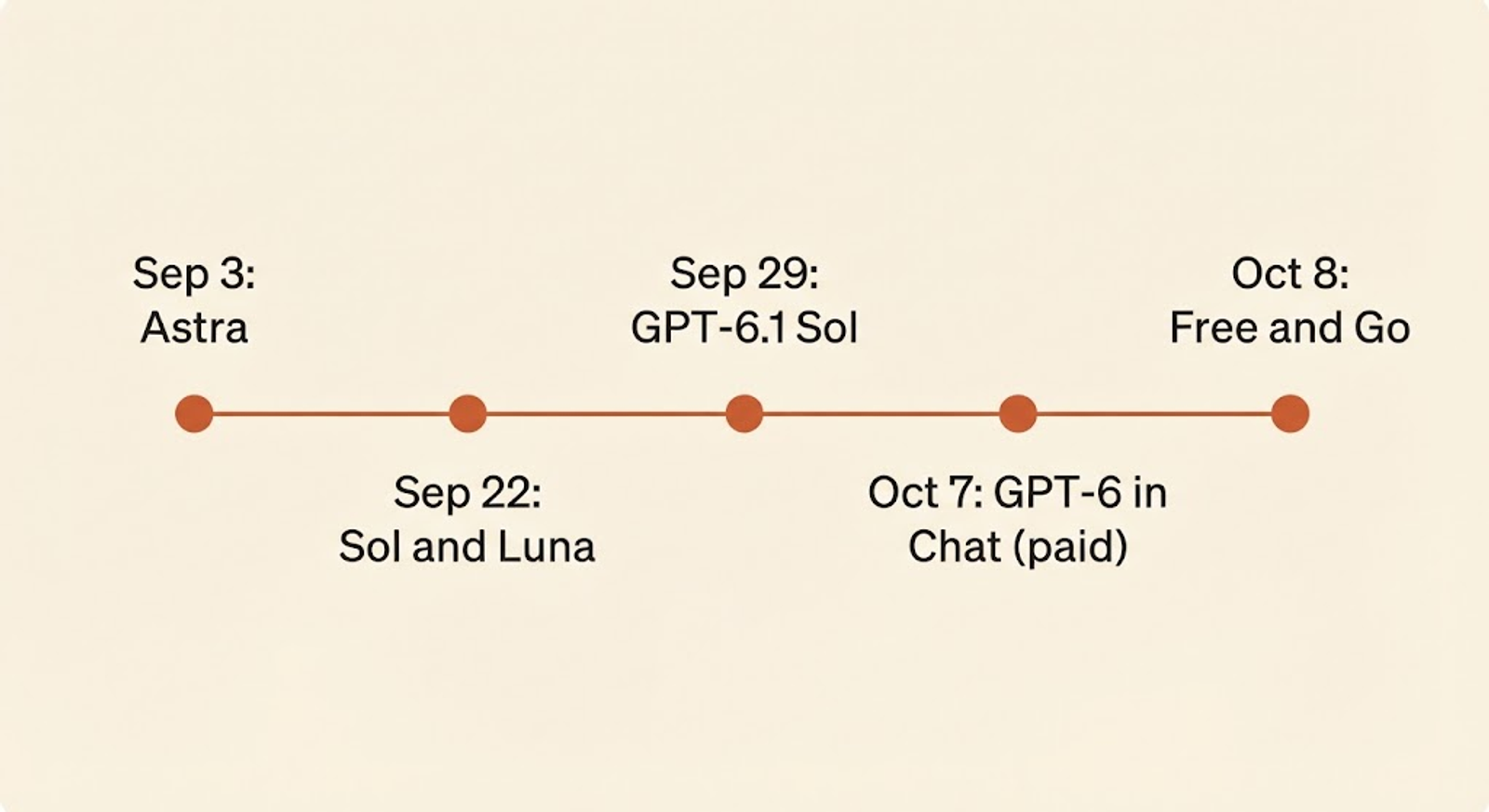
- September 3: Astra is announced, rolling out first to a limited set of organizations, then to paid ChatGPT plans, the API, Azure, and AWS Bedrock over the following days.
- September 4-5: A staggered rollout. OpenAI clarified that Pro, Enterprise, and Business Premium users had Astra in ChatGPT Work and Codex first, with Plus following.
- September 22: OpenAI adds GPT-6 Sol and GPT-6 Luna to the family.
- September 29: OpenAI announces GPT-6.1 Sol, a newer, cheaper variant.
- October 7-8: GPT-6 with Intelligent UI arrives in regular ChatGPT chat, as Sol for paid plans and Luna for Free and Go.
Some pages say Astra "launched September 4." That's the date it reached more paid users, not OpenAI's announcement date.
2. Astra vs Sol vs Luna: Which GPT-6 Do You Have?
Direct answer: Astra is the most capable and most expensive. Sol is the everyday workhorse, and Luna is the fast, cheap tier. Most ChatGPT users are on Sol or Luna.
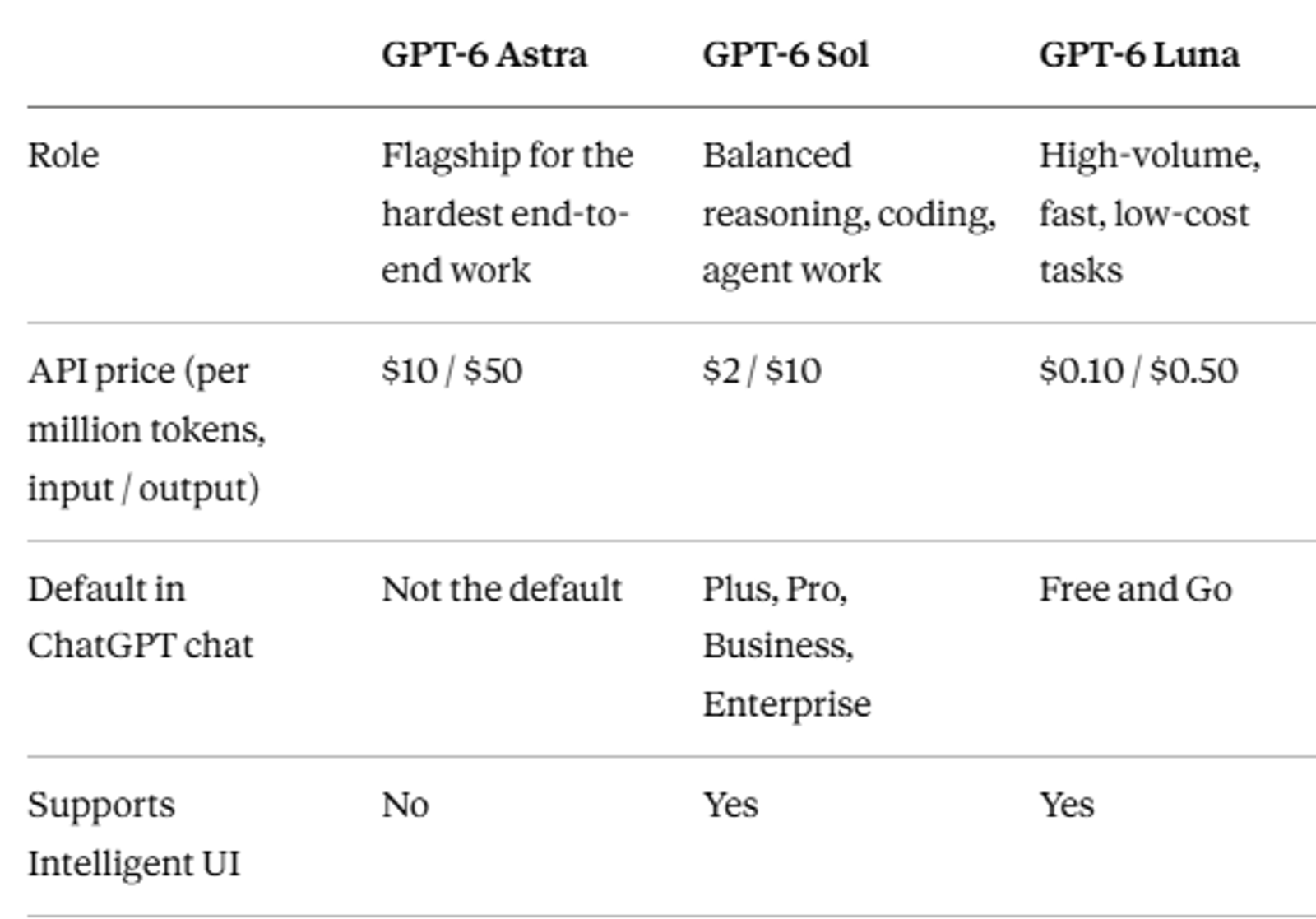
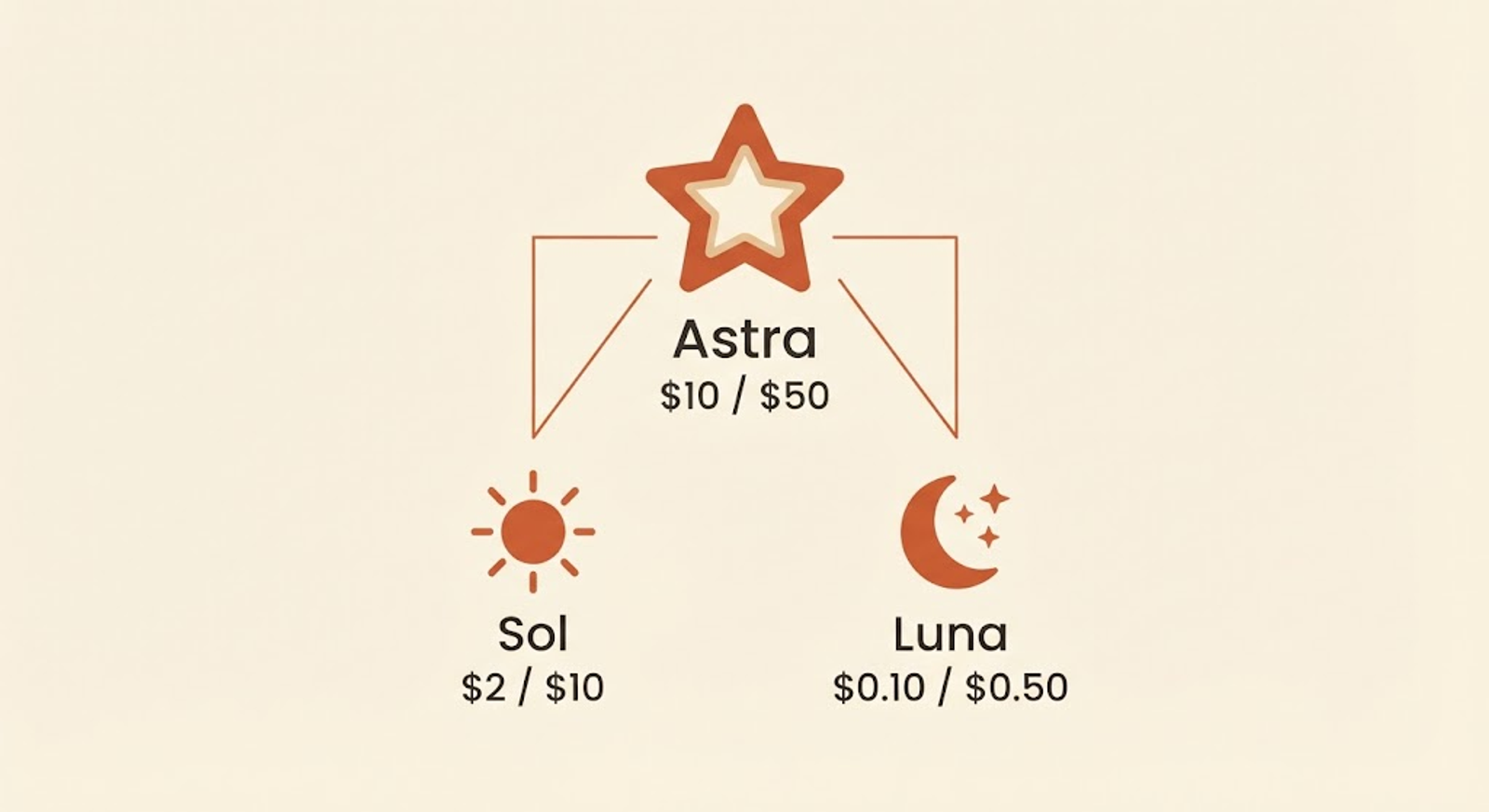
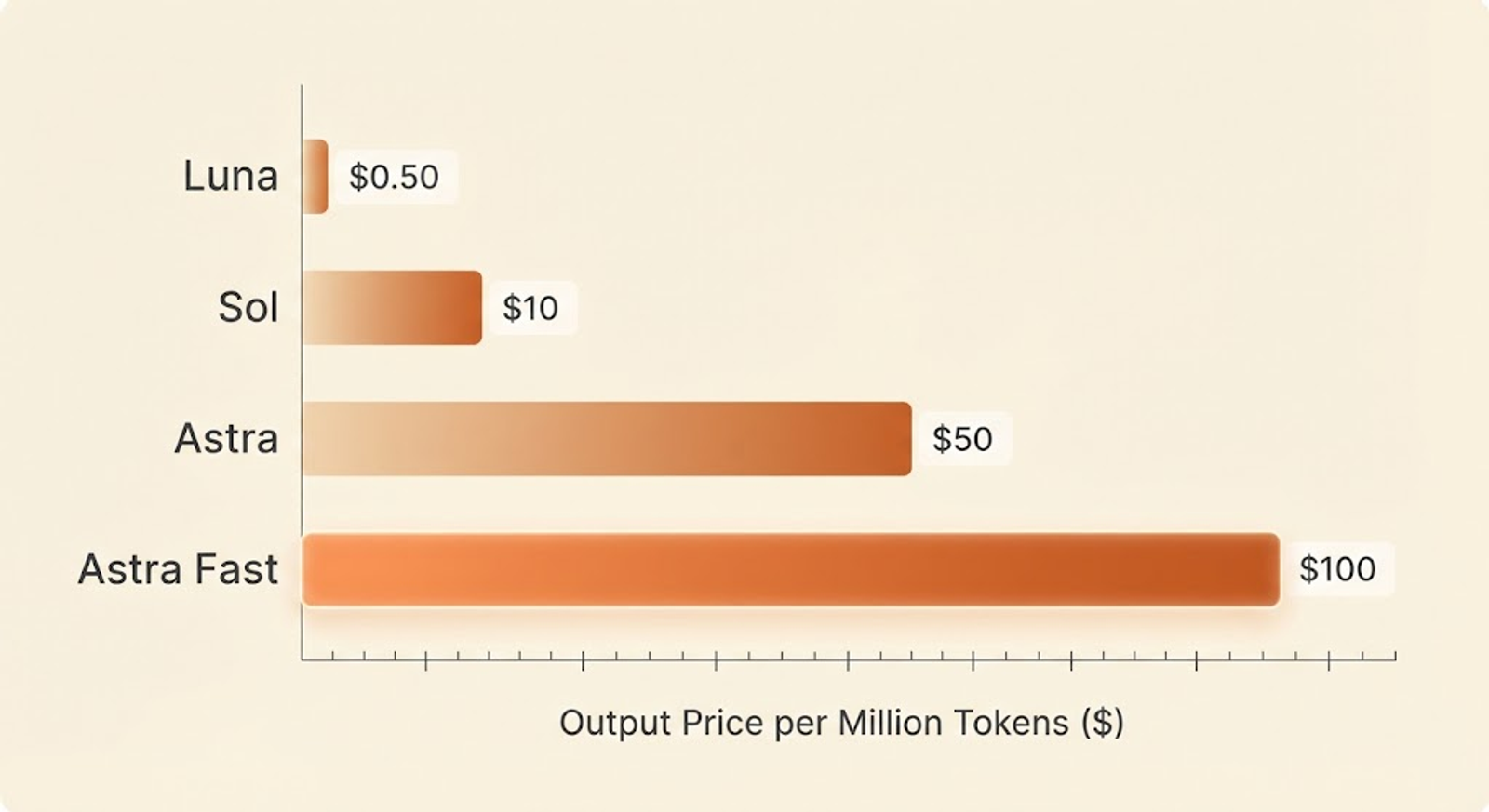
The Sol and Luna prices come from our breakdown of GPT-6 Sol vs Luna and the pricing table that confused everyone. Astra's price is five times Sol's on both input and output.
3. Who Gets Astra on Which Plan?
Direct answer: Free and Go users get no Astra. Plus gets it only in ChatGPT Work and Codex. Pro, Business, and Enterprise can reach it in chat under the label "GPT-6 Pro."
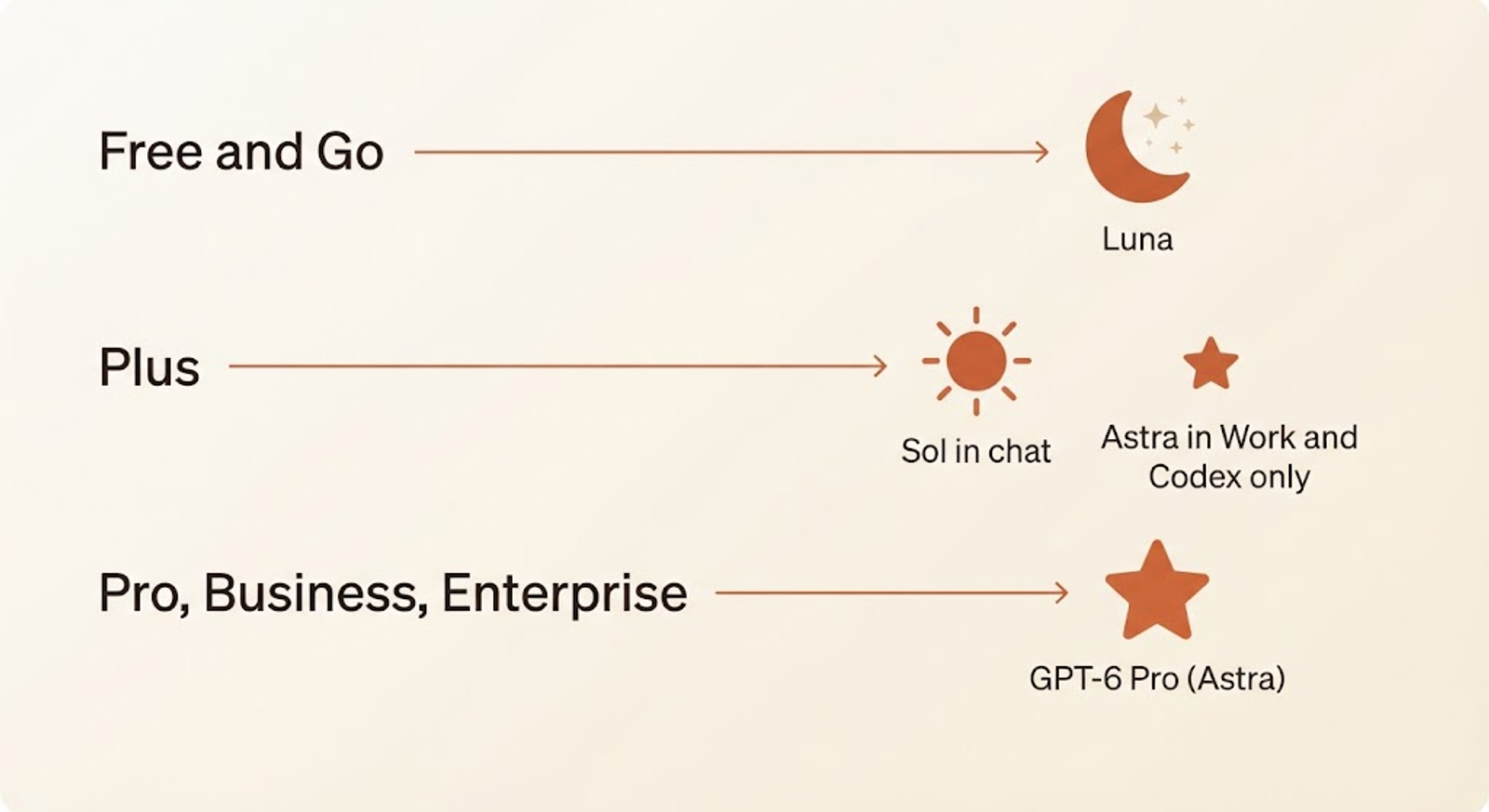
OpenAI's own launch page says Astra is for "all ChatGPT Plus, Pro, Business, and Enterprise users." That wording confused Plus subscribers, who opened chat and found nothing. Coverage of OpenAI's help-center language says Plus plans include Astra in Work and Codex, not in the regular chat picker.
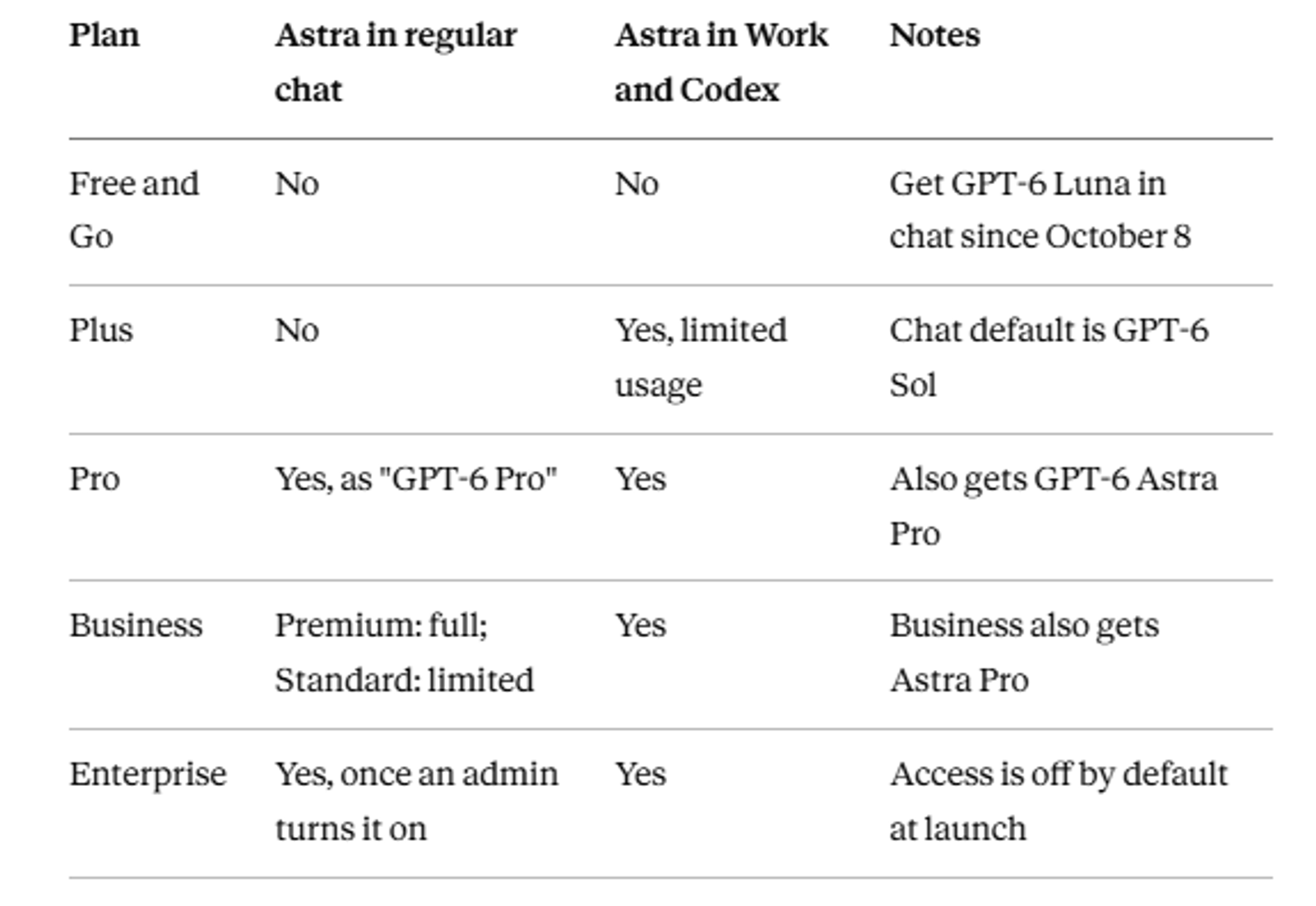
Two details are worth flagging. The picker reportedly never says "Astra" in chat: the entry reads "GPT-6 Pro," described as powered by GPT-6 Astra, while Work and Codex use the name "GPT-6 Astra" directly. And Astra usage counts inside your existing subscription allowance, with extra usage available as purchased credits.
4. How to Find Astra in ChatGPT, Step by Step
Step 1: Check your plan. Free and Go can stop here: Astra isn't included, and the chat model is GPT-6 Luna.
Step 2: If you're on Plus, open ChatGPT Work or Codex. Don't look in the regular chat model picker, since reports say Plus doesn't list Astra there.
Step 3: If you're on Pro or Business, open the chat model picker. Look for "GPT-6 Pro," the Astra-powered option. Business Standard has limited usage, and Premium uses its full allowance.
Step 4: If you're on Enterprise, ask your admin. Astra access is off by default and has to be switched on for the workspace.
Step 5: For the API, call gpt-6-astra. It is also offered through Microsoft Azure and Amazon Bedrock.
Step 6: Re-check after a few days. Plan access shifted twice within 48 hours of launch, so the picker you see today may not match a September guide.
The "Pro" option in chat doesn't support Intelligent UI, so if you're hoping for interactive charts and mini tools, you'll see those on the Sol or Luna chat models instead.
5. What Astra Does Well
Direct answer: On OpenAI's own numbers, Astra's biggest jumps are in computer use, agentic professional work, and terminal-based coding.
- Computer use: OpenAI reports 72.6% on OSWorld 2.0, against 65.7% for GPT-5.6 Sol, and says it finished tasks in about 47% less time.
- Professional agent tasks: 59.3% on Agents' Last Exam, against 53.6% for Sol, using roughly 65% fewer output tokens than Claude Opus 5 at the settings shown.
- Terminal coding: 57.9% on Terminal-Bench 4.0, against 37.3% for Sol.
- Workflow automation: 41.4% on AutomationBench, against 18.1% for Sol.
- Hard math and science: 97.6% on FrontierMath Tier 4 and 96.0% on GPQA Diamond.
- Long context: 1.05 million tokens of context and up to 128,000 tokens of output.
OpenAI also says Astra stays oriented as a task changes, asks focused questions when a missing detail would change the outcome, and pulls only relevant context into documents and slides. These are launch claims, run by OpenAI.
6. Where Astra Falls Short
Direct answer: The weak spots are on benchmarks OpenAI's own table includes, plus access friction, safety interruptions, and price.
Behind Claude on a Few Measures
OpenAI's comparison table lists Artificial Analysis's Intelligence Index at 61.2 for Astra, below Claude Fable 5.1 (65.7), Claude Opus 5 (63.1), and Claude Fable 5 (62.1). On Humanity's Last Exam with tools, Astra scores 57.2% against 65.0% for Fable 5.1. That sits awkwardly next to the "most intelligent model in the world" framing.
Near-Ties, Not Wins
On DeepSWE v1.1, Astra's 74.1% is barely ahead of Gemini 3.8 Flash (73.8%) and Claude Opus 5 (73.7%). On FrontierCode 1.1 Main, Astra's 53.3% trails Claude Fable 5 (53.5%) and Opus 5 (53.4%) by a hair. "State of the art" here means within a point or two.
Safety Checks Can Interrupt Real Work
Astra is the first OpenAI model rated at the Critical threshold for cybersecurity. At launch it refuses advanced security tasks such as building proof-of-concept exploits, and OpenAI says its extra safety checks can pause or stop legitimate work, including defensive security. In ChatGPT or Codex you may be asked to review an action before continuing, and in the API the task stops. OpenAI says it plans to loosen restrictions for defenders through its Daybreak program.
Access Is Confusing, and the Price Is High
Plus users were told Astra was coming and then couldn't find it in chat. At $10 and $50 per million tokens, Astra costs five times GPT-6 Sol, which is why OpenAI's cost-per-task claims matter more than the sticker price.
7. Astra vs Claude and Gemini
Direct answer: On OpenAI's table, Astra leads on most agentic and coding benchmarks and trails on a few reasoning measures. These comparisons were run by OpenAI, so treat them as vendor claims.
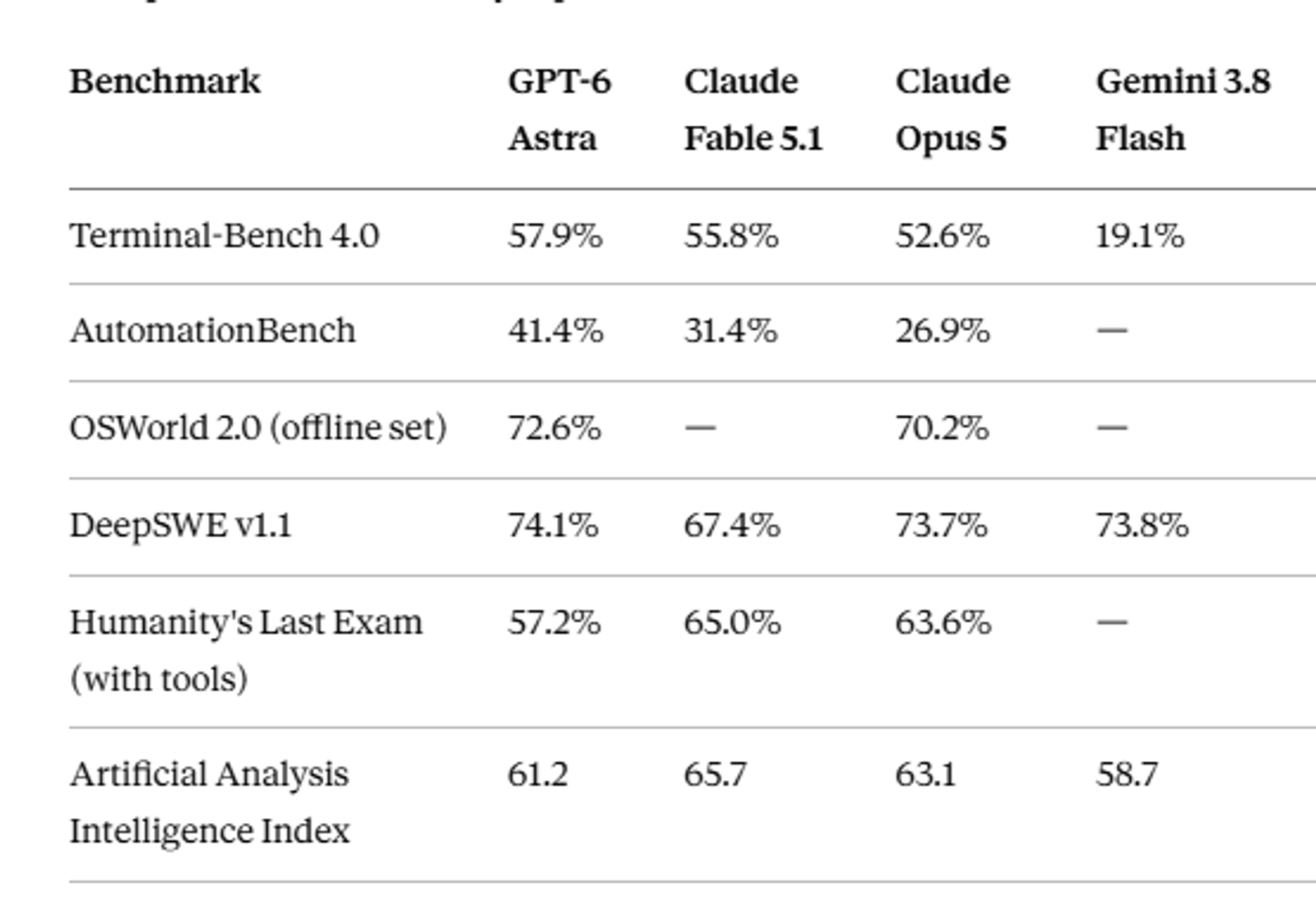
OpenAI's footnotes matter here. Some Claude results use modified settings described in Anthropic's system card, some "Fable" scores in the table come from a variant with fewer safeguards, and the ARC-AGI-3 result was run with a harness OpenAI changed to match real-world use. None of that makes the numbers wrong, but it's the reason to wait for independent runs before calling a winner.
8. What Astra Costs
Direct answer: The API price is $10 per million input tokens and $50 per million output tokens. In ChatGPT, Astra usage is included in your existing plan allowance, with extra usage sold as credits.
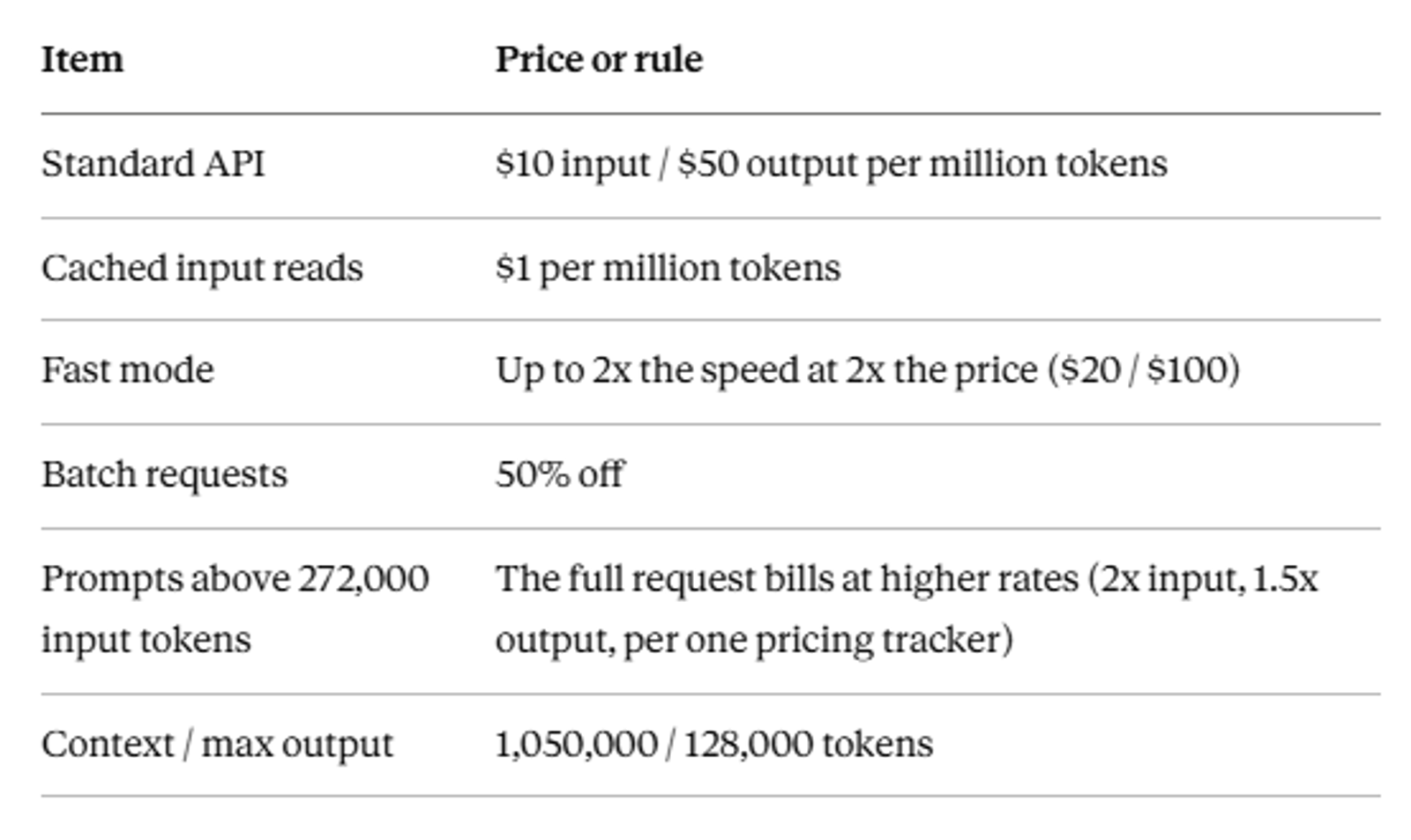
A few aggregator pages list Astra at $4 / $20. That's an older GPT-5.6 price, not Astra's, so check OpenAI's live pricing page before budgeting.
Cheaper Per Token Isn't Always Cheaper Per Task
OpenAI argues Astra's efficiency offsets its price: it says Terminal-Bench 4.0 costs roughly 9% less per task than Sol and about 63% less than Fable 5.1, because Astra uses fewer tokens. Those are OpenAI's estimates. If your workload is simple, Sol or Luna is almost certainly the better value, and GPT-6.1 Sol is reported to deliver Astra-level coding at a fifth of the price.
9. Real-World Examples From OpenAI's Launch
Everything in this section is OpenAI's own demonstration or a customer quote it published.
- Circuit board layout: a condensed 15-second playback of Astra laying out a PCB in KiCad, which OpenAI says took 2 minutes 54 seconds.
- From model to walkable scene: Astra modeling a house in Blender and turning it into a walkable Unreal Engine 5 scene.
- Math: OpenAI says Astra helped establish a bound of 186 on how close infinitely many pairs of primes occur, improving on a recent bound of 240. OpenAI shared proofs, but I didn't see independent verification in the sources I read.
- Creative workflows: Higgsfield's CEO is quoted saying Astra handled complex creative workflows with up to 20% fewer tokens than other models the company tested.
10. Why Many GPT-6 Guides Are Already Out of Date
Direct answer: Most September guides predate OpenAI's October 7 change, so they describe a ChatGPT that no longer exists.
Several say GPT-5.6 Sol "stays the default everywhere." Since October 7, regular chat runs GPT-6 Sol (paid) or GPT-6 Luna (Free and Go), with Intelligent UI, which lets ChatGPT answer with charts, buttons, forms, and small tools. OpenAI says this update applies to Chat only, and the models powering Work and Codex didn't change.
So if a guide says free users have GPT-5.6, or that Plus has Astra in chat, check its date. One more thing about timing: OpenAI says rollouts are gradual, so you may not see a new model the hour it's announced.
Recommended For You:
Final Thoughts
"GPT-6" now means three different things depending on your plan, and that's the whole story behind the confusion. Astra is the premium engine, Sol is what most paying users chat with, and Luna is what everyone else gets for free.
Before you pay for anything because of an Astra headline, check which model your plan actually runs and whether your work needs the top tier at all.
Sources
- OpenAI, "GPT-6 Astra: A new generation of intelligence" (September 3, 2026, with later update notes): availability, pricing, benchmark tables, safety and cyber details (fetched directly)
- OpenAI, "GPT-6 and Intelligent UI for everyone" (October 7, 2026): ChatGPT rollout, Sol and Luna by plan, scope of the update (fetched directly)
- BleepingComputer, coverage of Astra reaching ChatGPT Plus in Work and Codex
- Plan-access explainers and pricing trackers (GeoToolbox, The AI Career Lab, OrcaRouter, APIYI, Guptadeepak, CloudPrice), used to cross-check plan access, the "GPT-6 Pro" label, the 272K-token pricing tier, and rankings
- Coverage of the October 7 rollout (aicatchup, findskill, letsdatascience, and others) for the statement that the Pro reasoning option uses Astra and lacks Intelligent UI
- Not opened for this guide: OpenAI's help center, ChatGPT release notes, and system cards
Suggested Related Articles:
Frequently Asked Questions
Has GPT-6 been released?+
Yes. GPT-6 Astra was announced September 3, 2026, GPT-6 Sol and Luna followed September 22, and GPT-6 reached regular ChatGPT chat with Intelligent UI on October 7-8.
What is the newest GPT?+
As of October 18, 2026, the GPT-6 family: Astra is the flagship, Sol and Luna are the everyday tiers, and GPT-6.1 Sol was announced September 29.
Is GPT-6 Astra free?+
No. Free and Go users get GPT-6 Luna in chat. Astra is included in paid plans, with Plus limited to Work and Codex.
How do I use GPT-6 in ChatGPT?+
Open regular chat. Paid plans get GPT-6 Sol and Free and Go get GPT-6 Luna, rolled out gradually. To reach Astra, use Work or Codex on Plus, or the "GPT-6 Pro" option on Pro and Business plans.
What does Astra mean?+
Astra is Latin for "stars." OpenAI hasn't explained the name in the sources I read.
Can I download GPT-6 or Astra?+
No source describes a download. GPT-6 is available through ChatGPT and the API, and a "free download" page should be treated as unverified.
Is Astra better than Claude or Gemini?+
On OpenAI's own table, Astra leads on many agentic and coding benchmarks and trails Claude on a few reasoning measures. Wait for independent testing before treating any single ranking as settled.
What does GPT-6 Astra cost in the API?+
$10 per million input tokens and $50 per million output tokens, with $1 cached reads and 50% off batch requests, per OpenAI and pricing trackers.
Keep reading
Suggested Related Articles
How to Add Auto AI Captions to Video Free (Step-by-Step Guide)
Learn how to add auto AI captions to your video for free. Follow simple steps, fix common caption mistakes, and compare free tools like Auto Seedance, CapCut and YouTube.
How to Master AI Filmmaking: A Tool-Agnostic Workflow With Real Costs and Limits
Making one AI clip is easy; making a film is a different skill. This guide covers the tool-agnostic workflow, a first-scene exercise, where it breaks, and what a 10-second scene, a minute, and five minutes cost at current public prices.
The Mother's Monster: How a Pakistani Creator's AI Film Hit 50M Views, and 10 AI Movie Generators to Make Your Own
The Mother's Monster, a 28-minute AI film by Pakistani creator Zahid Iqbal, drew 50M+ views by the studio's count. This guide separates what's confirmed from what isn't, shows what a similar film could cost, and compares 10 AI movie generators to try.
Claude Startups Program After the Pause: What's Still Free, What Changed, and How to Apply
Anthropic expanded the Claude Startups program on October 6, then paused its free Team year and $1,000 API credit days later. This guide covers what's still available, who qualifies, what the dollar figures mean, and how to apply, with every claim sourced.